
The Breaker Is the Ceiling: Sizing 0.01 BTC Around a Household Circuit
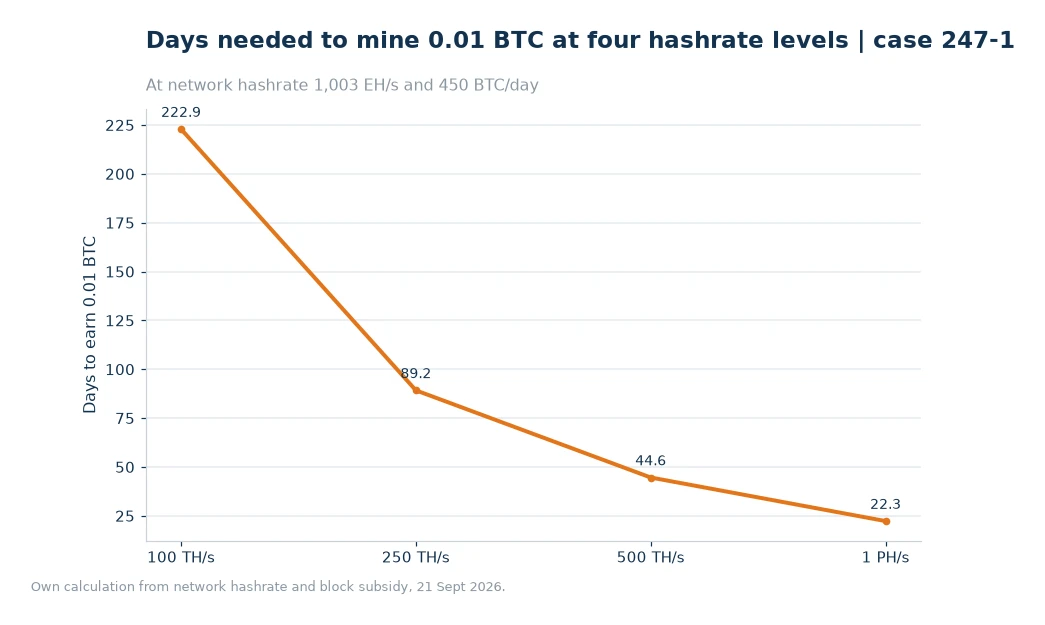
Mining plans usually start with a coin target and end at the fuse box. A 0.01 BTC goal takes 222.9 days at 100 TH/s, 89.2 days at 250 TH/s, 44.6 days at 500 TH/s and 22.3 days at 1 PH/s on the 21 September 2026 network total. The first figure fits a domestic circuit; the last needs a dedicated feed. Where the plan falls between them is an electrical question before it is a mining one.
Key takeaways
- 0.01 BTC takes 222.9 days at 100 TH/s; reaching 1 PH/s cuts that to 22.3 days.
- At 20 J/TH, 100 TH/s draws about 2,000 W, which is a 240 V circuit at roughly 8.3 A.
- Breakers are sized for continuous load at 80%, so a 20 A circuit does not deliver 20 A of mining.
- A larger machine shortens the target but may require an electrician before it can be switched on.
Two Limits, and Only One of Them Is Copper
A miner's output is limited by share of the network. A miner's practical size is limited by the cable, the breaker and the heat that leaves the room. Those two ceilings are unrelated, and confusing them produces bad purchases: a machine chosen for its hash rate that cannot run at full load on the available supply will behave like a smaller machine with a larger invoice.
Start from the panel. The number written on the breaker is a protection threshold, not a delivery target, and continuous loads are normally planned at 80% of it. A 20 A breaker on a 240 V circuit therefore supports around 16 A of sustained draw, or roughly 3.8 kW. That single figure filters the hardware list faster than any spreadsheet of specifications.
What 0.01 BTC Asks of a Circuit
At 100 TH/s the daily credit is 0.00004487 BTC, so the target lands after 222.9 days. Modern hardware in that range typically runs near 20 J/TH, which means about 2,000 W at the wall before fans and conversion losses. On 240 V that is 8.3 A, comfortably inside a 16 A continuous allowance.
Move to 250 TH/s and the same efficiency implies 5,000 W, or 20.8 A at 240 V. Now the circuit is marginal: a single 30 A feed would carry it, but a shared household supply probably will not. At 500 TH/s the draw is around 10 kW, and at 1 PH/s around 20 kW. Those are not appliance loads any more; they are small electrical installations with their own distribution board, and often their own cooling design.
Efficiency is the variable that buys headroom. A machine at 18 J/TH draws 10% less than one at 20 J/TH for the same hash rate, which can be the difference between fitting a circuit and rebuilding it. Check the wall-plug figure rather than the chip figure, because the power supply and fans are part of the load, and that extra draw is what the breaker sees on a hot afternoon.
The Pool Reading That Moves the Finish Line
The ViaBTC Pool Hashrate figure and the network total beside it decide how much a given machine earns, and both drift. A circuit does not drift, so the electrical plan is the stable half of the decision. Build the hardware around the supply, then check the pool numbers to see what that hardware currently produces.
Pool Luck belongs in the same review. Under PPLNS, a run of unlucky blocks can make a correctly sized machine look as though it is underperforming, and the temptation is to add hash rate. Adding load to fix a variance problem is the wrong response: it raises the power bill without changing the distribution.
Use the Profit Calculator to convert a candidate hash rate into daily coins, then hold that against the circuit's continuous allowance. If the two disagree, the circuit wins. The Statistics page keeps the network inputs in one place when the figure needs rechecking later.
Where the Watts Actually Go
A 2,000 W miner running all day consumes 48 kWh. At a tariff of $0.06 per kWh that is $2.88 a day. The same machine at 100 TH/s produces 0.00004487 BTC, worth $3.80 at $84,692, so the gross margin before pool fees is about ninety cents a day. Every watt saved or lost is therefore a large fraction of the margin, not a rounding error.
This is why the electrical work should be priced as part of the hardware, not as an afterthought. A circuit upgrade that costs several hundred dollars can consume months of margin at this scale. If the upgrade is needed only to reach a target a few weeks sooner, the arithmetic rarely supports it.
The Middle Ground at 250 and 500 TH/s
The intermediate steps are where most home operations land. At 250 TH/s the target falls to 89.2 days, under three months, and the draw is close to a dedicated 30 A circuit. At 500 TH/s the target is 44.6 days and the draw needs a properly designed feed, usually with its own ventilation plan.
Neither step is inherently better. The shorter wait has to be paid for in installation and cooling, and those costs are fixed rather than proportional. A miner who already has a suitable outbuilding will find 500 TH/s cheaper to add than one renting a flat with a shared supply.
Deciding With the Panel Open
Stand at the panel with the main breaker off and read the spare capacity honestly. Then convert the candidate hash rate into watts, watts into amps at your voltage, and compare that with 80% of the breaker rating. The table does that conversion for four hash rates at 20 J/TH and 240 V.
| Hash rate | Wall power | Current at 240 V | Days to 0.01 BTC |
|---|---|---|---|
| 100 TH/s | 2.0 kW | 8.3 A | 222.9 |
| 250 TH/s | 5.0 kW | 20.8 A | 89.2 |
| 500 TH/s | 10.0 kW | 41.7 A | 44.6 |
| 1 PH/s | 20.0 kW | 83.3 A | 22.3 |
Worked example
Take the 100 TH/s case and follow it from hash rate to a net daily figure.
- Network output: 144 × 3.125 = 450 BTC a day.
- Per terahash: 450 ÷ 1,003,000,000 = 0.00000044865 BTC.
- At 100 TH/s: 0.00004487 BTC a day, or 0.00004487 × 84,692 = $3.80.
- Days to 0.01 BTC: 0.01 ÷ 0.00004487 = 222.9.
- Power at 20 J/TH: 100 × 20 = 2,000 W, or 48 kWh a day.
- Electricity at $0.06/kWh: 48 × 0.06 = $2.88.
- Gross margin before pool fees: 3.80 − 2.88 = $0.92 a day.
- The same arithmetic at 250 TH/s gives 5,000 W, 120 kWh and $7.20 a day in power against $9.50 of coins.
Frequently asked questions
Can a 20 A circuit run a 250 TH/s miner?
Not continuously at 20 J/TH. The load is about 5,000 W, or 20.8 A at 240 V, while a 20 A breaker is normally planned for 16 A of sustained draw. That machine needs a larger dedicated circuit.
Does a more efficient miner change the target date?
It changes the power bill, not the coin output. The finish date depends on share of network hash rate, so efficiency buys margin and circuit headroom rather than a shorter wait.
Is it worth upgrading the panel for a faster target?
Only if the cost is small against the extra coins. Compare the installation quote with the value of the weeks saved at the current daily rate; at 100 TH/s a few hundred dollars is many months of margin.
Measure the Supply Before the Hash Rate
Write the continuous allowance on a card and keep it beside the hardware shortlist. Any machine above that line needs an electrician's opinion before it needs a profitability estimate. This order of work saves the most common and most expensive mistake in home mining: buying output the building cannot deliver.
Once the supply is settled, the coin target follows from the formula, and the pool page tells you what the chosen machine is currently worth. The circuit is the part you cannot renegotiate with a difficulty adjustment.
Inputs come from the pool state, calculator and statistics pages at ViaBTC[1], read 21 Sept 2026. Network hashrate 1,003 EH/s, difficulty 132.76 T, 3.125 BTC subsidy, 144 blocks daily, BTC $84,692. Power examples assume 20 J/TH at $0.06/kWh. Published 24 Oct 2026.